
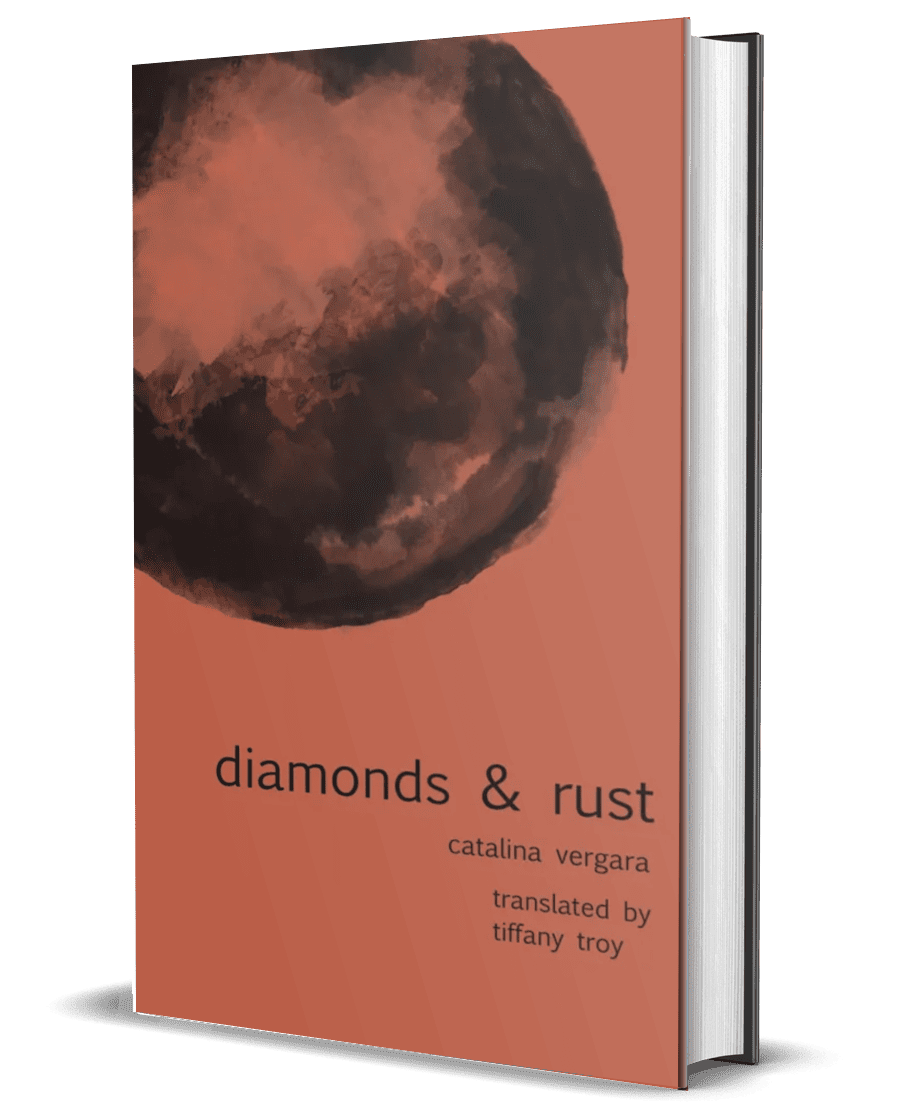
Diamonds & rust by Catalina Vergara, translated by Tiffany Troy
Diamonds & rust by Catalina Vergara, translated by Tiffany Troy, is a bilingual poetry collection exploring queer love, memory, and political history, inspired in part by Diamonds & Rust. Set against the legacy of Chile’s turbulent past — including the era of Augusto Pinochet and the fall of Salvador Allende — the poems blend personal emotion with cultural and cosmic imagery, reflecting feminist resistance, historical trauma, and imaginative reflection shaped by the influence of poet Raúl Zurita.

About The Book
In this tremendous chapbook, Mars is crummy, rusty, but alive, the planet confronting its feminine counterpart. The lyrical subject is enigmatic (masculine), or rather, enigmatic (feminine). It slips between lowercase letters, between caesuras and enjambments, leaping between silences and blank spaces behind the melancholy of romantic or emotional misunderstandings….. Vergara contrasts the pristine, clear, naked transparency of the diamond with its companion fragility, with the dirty, dark, and discomforting texture of rust. We all desire diamonds. No one wants rust, or do we?
En esta tremenda obra, Marte siendo desierto, oxidado, pero con vida, enfrentado el planeta a su contraste femenino. El sujeto lírico es enigmático, o más bien enigmática. Se cuela entre las minúsculas y los desbordes de la pausa versal y los encabalgamientos, salta entre los silencios y los espacios en blanco tras la melancolía de ese desencuentro amoroso/afectivo….. Vergara contraste entre lo prístino, claro, desnudo de la transparencia en el diamante y su fragilidad, versus la textura sucia, oscura y poco deseada del óxido. Todos queremos diamantes, pero nadie quiere el óxido ¿o sí?
—BLANCA HERNÁNDEZ, AUTHOR OF ENMIRLADA
Diamonds and Rust es, en definitiva, un poemario que interroga el deseo y la forma en que lo habitamos: como carencia, como fantasía, como forma de contemplación. Explora esa línea limite donde el otro amado puede volverse tan lejano que termina por convertirse en figura artística, y no en presencia viva. Y, sin embargo, también hay en estos versos una necesidad entre líneas de ser tocado, de romper la distancia, de ser deseado también, de romper con la poesía que requiere de decoro para transmitir una emoción tan compleja como lo es el amar.
diamonds & rust is, ultimately, a chapbook that interrogates desire and the way we inhabit it: as an absence, as fantasy or as a form of contemplation. It explores that limit where the beloved other can become so distanced from the self that they transform into an artistic figure rather than a living presence. And yet, between these lines also exists a need to be touched, to break the distance, to also be desired, and to break with the decorum poetry requires to convey an emotion as complex as to love.
The sixth dimension is essentially the “multiverse” – it contains all possibilities. The poet imagines a kind of fulfillment in the silence of dream that spells out the essence of the sixth dimension. In a note, Vergara explains her drive behind diamonds & rust, “El poemario es una sutura entre mi dolor, el de Baez y el silencio de aquellos que sufren por un amor imposible, una relacion corosiva.” (“The collection of poems is a suture between my pain, Baez’s pain, and the silence of those who suffer from an impossible love, a corrosive relationship.”) Re-written silence means suffering may be redeemed in another world, a parallel universe. Call it wish-fulfillment or liken it to the 18th century German “Sturm und Drang” movement with its emphasis on intense emotion, the impulse is sincere, searing.